Can we predict diabetic CKD progression before albuminuria or eGFR starts to deteriorate?
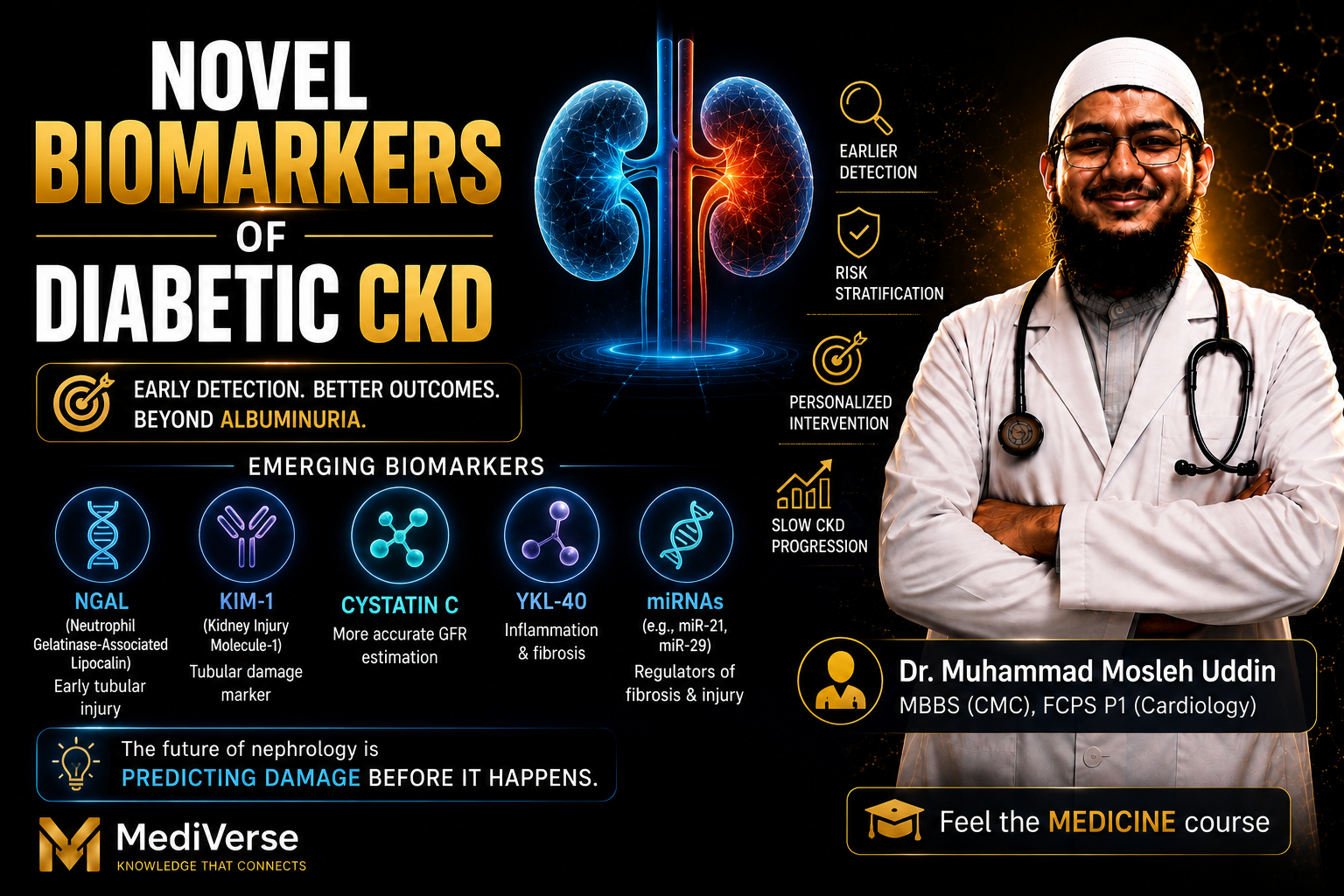
🔴 Can we predict DKD progression before albuminuria or eGFR starts to deteriorate?
আমরা এখনো Diabetic Kidney Disease (DKD) নির্ণয়ের জন্য মূলত albuminuria এবং eGFR-এর উপর নির্ভর করি।
কিন্তু সমস্যা হলো, এই marker গুলো অনেক সময় kidney damage শুরু হওয়ার অনেক পরে দেখা যায়।
তাই বর্তমান nephrology research-এর সবচেয়ে concern এর বিষয় হলো,
🔴 Can we predict DKD progression before albuminuria or eGFR starts to deteriorate?
এই প্রশ্নের উত্তর খুঁজতেই বিশ্বজুড়ে চলছে intensive research on novel biomarkers.
এবং আলহামদুলিল্লাহ আমরা পেয়েও গেলাম কিছু promising early biomarkers of diabetic CKD.
একটু briefly বলি আপনাদের ইনশা আল্লাহ।
🔴 Urinary NGAL (Neutrophil Gelatinase-Associated Lipocalin)
📌 Detects early tubular injury
📌 May rise even before albuminuria
🔴 KIM-1 (Kidney Injury Molecule-1)
📌Marker of proximal tubular damage
📌Predicts faster kidney function decline
🔴 Cystatin C
📌More sensitive than serum creatinine
📌Better reflects early decline in GFR
🔴 Urinary L-FABP
📌Indicates renal hypoxia and oxidative stress
📌 Useful in detecting early DKD
🔴 TNFR-1 & TNFR-2
📌Among the strongest predictors of DKD progression
📌Associated with future end-stage kidney disease
🔴 Soluble Uromodulin
📌Reflects tubular health
📌Lower levels may indicate higher risk of progression
🔴 Urinary MCP-1
📌Marker of renal inflammation
📌Emerging predictor of DKD progression
Kidney Extracellular Vesicle Biomarkers
📌A promising frontier in precision nephrology
📌Still largely confined to research settings
যদি ভবিষ্যতে এই biomarkers-গুলো routine clinical laboratory তে অংশ হয়ে যায়, তাহলে আমরা high-risk patients দের অনেক আগেই শনাক্ত করতে পারবো ইনশা আল্লাহ। এবং Chronic Kidney Disease (CKD) progression prevent করতে পারবো খুব initial stage থেকেই ইনশা আল্লাহ।
এই info গুলো যেই research paper এর উপর based করে লিখা সেগুলোর link নিচে দিলাম আলহামদুলিল্লাহ।
Dr. Muhammad Mosleh Uddin
MBBS (CMC). FCPS P1 (Cardiology)