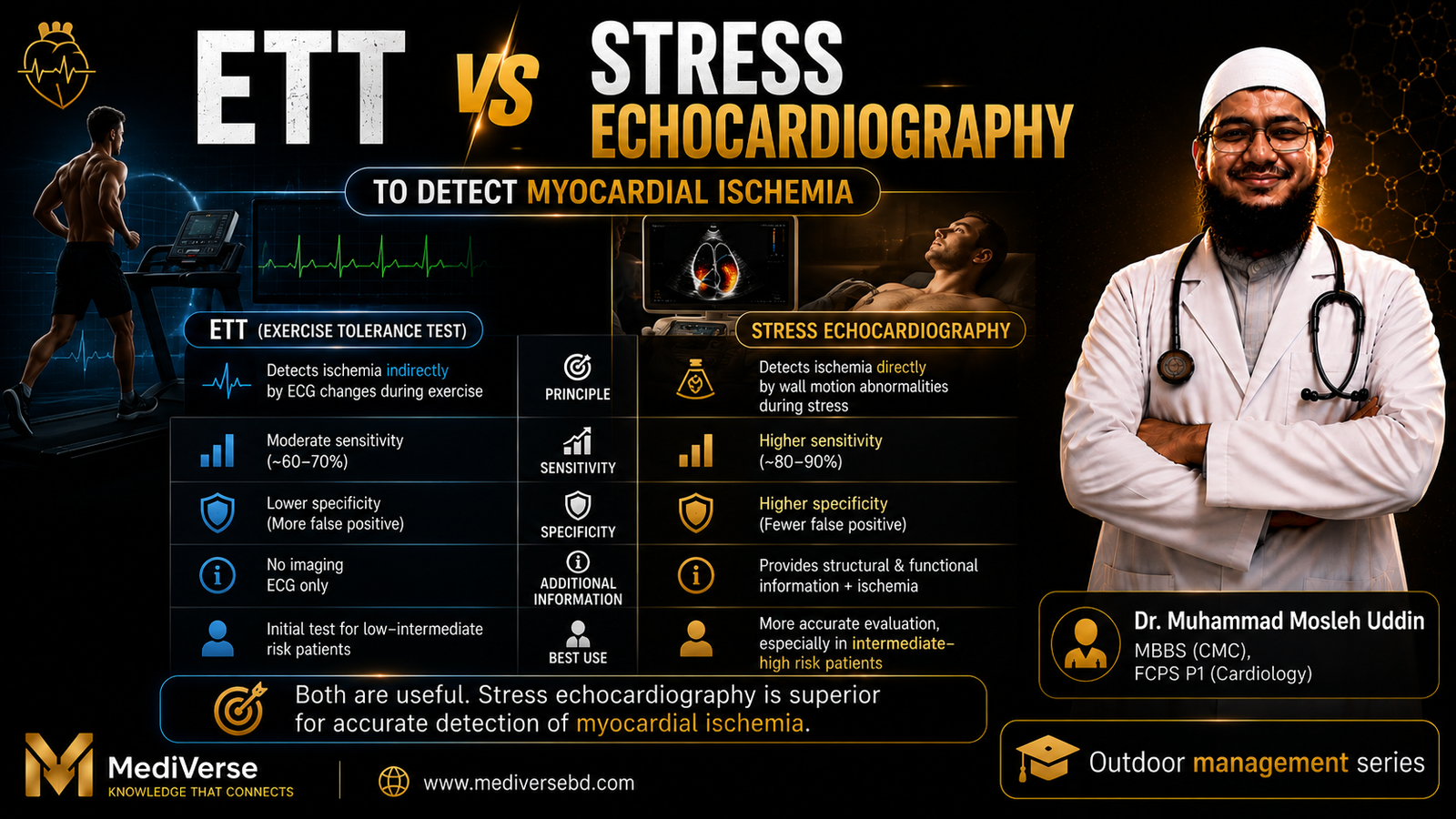
Stress echocardiography is more sensitive than ETT to detect stable angina
Stress echocardiography is more sensitive than ETT to detect stable angina
🔴 The classic myocardial ischemic cascade is:
📌 Myocardial perfusion abnormality (PET myocardial perfusion scanning) - earliest finding
📌 Regional wall motion abnormality (RWMA) → detected by Stress echocardiography
📌 Exertional ECG changes (horizontal or down sloping ST-segment depression, symmetrical T inversion) → detected by ETT
So, between Echo and ETT, Stress echocardiography detects ischemia earlier and is more sensitive than ETT because 🔴 Myocardial contractility becomes abnormal before ST-segment changes appear.
📌 ETT detects ischemia later when electrical changes (ST depression, T inversion) develop during exercise.
🔴 Sensitivity for detecting myocardial ischemia:
📌 Stress Echo: ~80–85%
📌 ETT: ~68%
📌 Resting ECG and resting Echo are often normal in stable angina unless there has been a previous MI or ongoing acute ischemic events .
🔷 Note
📌 Stress echocardiography (earlier and more sensitive to detect myocardial ischemia
📌 Exercise ECG (ETT) (later than stress echo)
📌 Resting ECG & Resting echo often may be completely normal in stable angina.
🔷 Summary
📌 Which one detect exertional myocardial ischemia (stable angina) earlier?
- Stress Echocardiography
📌 Which is the usual first-line functional test in a patient who can exercise?
- Exercise Treadmill Test (ETT), although many contemporary guidelines increasingly favor imaging-based stress tests (e.g., stress echo or myocardial perfusion scanning) when available because of their higher diagnostic accuracy.
References
Davidson's Principles and Practice of Medicine, 25th ed.
Harrison's Principles of Internal Medicine, 22nd ed.
2024 ESC Guidelines on Chronic Coronary Syndromes
ACC/AHA Guidelines on Chronic Coronary Disease
Dr. Muhammad Mosleh Uddin
MBBS (CMC), FCPS trainee (Cardiology)
Outdoor management series