Prescribing only loop diuretics in chronic heart failure is valueless actually.
Prescribing only loop diuretics in chronic heart failure is valueless actually.
Because approximately after 4 weeks of starting, it doesn’t work. This is called diuretics braking.
🔴 When does diuretic braking occur?
📌 Acute braking:
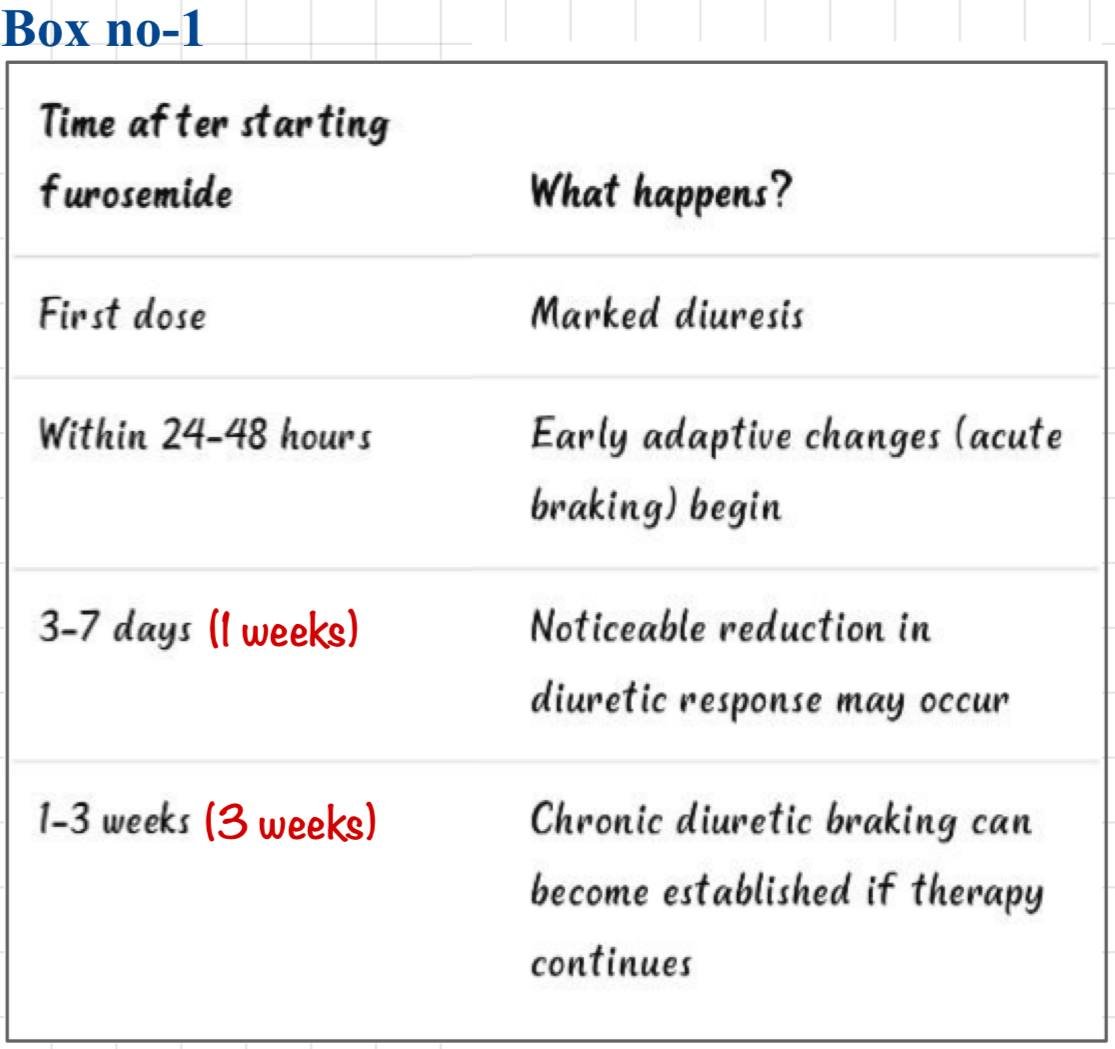
Begins within 1–2 days after starting furosemide.
📌 Chronic diuretic braking: Becomes clinically significant after several days to a few weeks of continuous therapy, especially if sodium intake is not restricted.
🔴 Why does it happen?
The kidney adapts to chronic loop diuretic therapy by:
📌 Increasing sodium reabsorption in the distal convoluted tubule and collecting duct
📌 Activating the renin-angiotensin-aldosterone system (RAAS).
📌 Increasing sympathetic nervous system activity.
As a result, the same dose of furosemide produces less natriuresis and diuresis over time.
Please see the Box-1 (attached in comment box)
🔴 How to overcome diuretic braking?
📌 Restrict dietary sodium (<2 g/day sodium, unless contraindicated).
📌 Increase the loop diuretic dose or frequency.
📌 Use intravenous furosemide if oral absorption is poor.
📌 Add a K+ sparing diuretic (e.g. Spironolactone) for sequential nephron blockade when appropriate.
Treat underlying causes of diuretic resistance (e.g., worsening heart failure, CKD, NSAID use, poor adherence).
🔷 Note:
Diuretic braking is not primarily due to tolerance to the drug itself. It is mainly due to adaptive renal sodium retention and distal nephron remodeling, which typically develops over days to weeks.
💢 Clinical note
So, prescribing only loop diuretics in Heart failure is valueless actually.
Because approximately after 4 weeks of starting, it doesn’t work actually.
🔴 Is it rational only prescribing Furosemide in chronic heart failure?
No. In most patients with chronic heart failure, prescribing only furosemide is not rational—especially in HFrEF.
🔴 Why?
Furosemide (loop diuretic) mainly:
📌Removes excess salt and water
📌Relieves pulmonary congestion, peripheral edema, and dyspnea
📌Improves symptoms and fluid status
But it does not adequately modify the underlying disease process or provide the mortality benefit of guideline-directed heart failure therapy.
In chronic HFrEF, typical treatment includes:
The 4 pillars of GDMT:
📌ARNI (sacubitril/valsartan) or ACE inhibitor/ARB
📌Evidence-based β-blocker
📌Mineralocorticoid receptor antagonist (MRA) — spironolactone/eplerenone
📌SGLT2 inhibitor — dapagliflozin/empagliflozin
Furosemide is added when there is fluid retention/congestion and its dose is adjusted according to volume status.
💢 Furosemide = symptomatic relief of congestion
💢 GDMT = disease modification + reduction in hospitalization/mortality
So, furosemide alone may be appropriate temporarily in a patient presenting mainly with congestion while other therapies are being initiated or titrated, but long-term monotherapy is generally inadequate for chronic HFrEF. Diuretics are recommended when there is evidence of fluid retention.
References
Brenner & Rector's The Kidney, latest edition
Goodman & Gilman's The Pharmacological Basis of Therapeutics, latest edition
Katzung's Basic & Clinical Pharmacology, latest edition
UpToDate: Causes and treatment of diuretic resistance in heart failure
Full 2022 AHA/ACC/HFSA Heart Failure Guideline
Dr. Muhammad Mosleh Uddin
MBBS (CMC), FCPS trainee (Cardiology)
💢Outdoor management series