Lactulose should be avoided for constipation in presence of IBS (C)
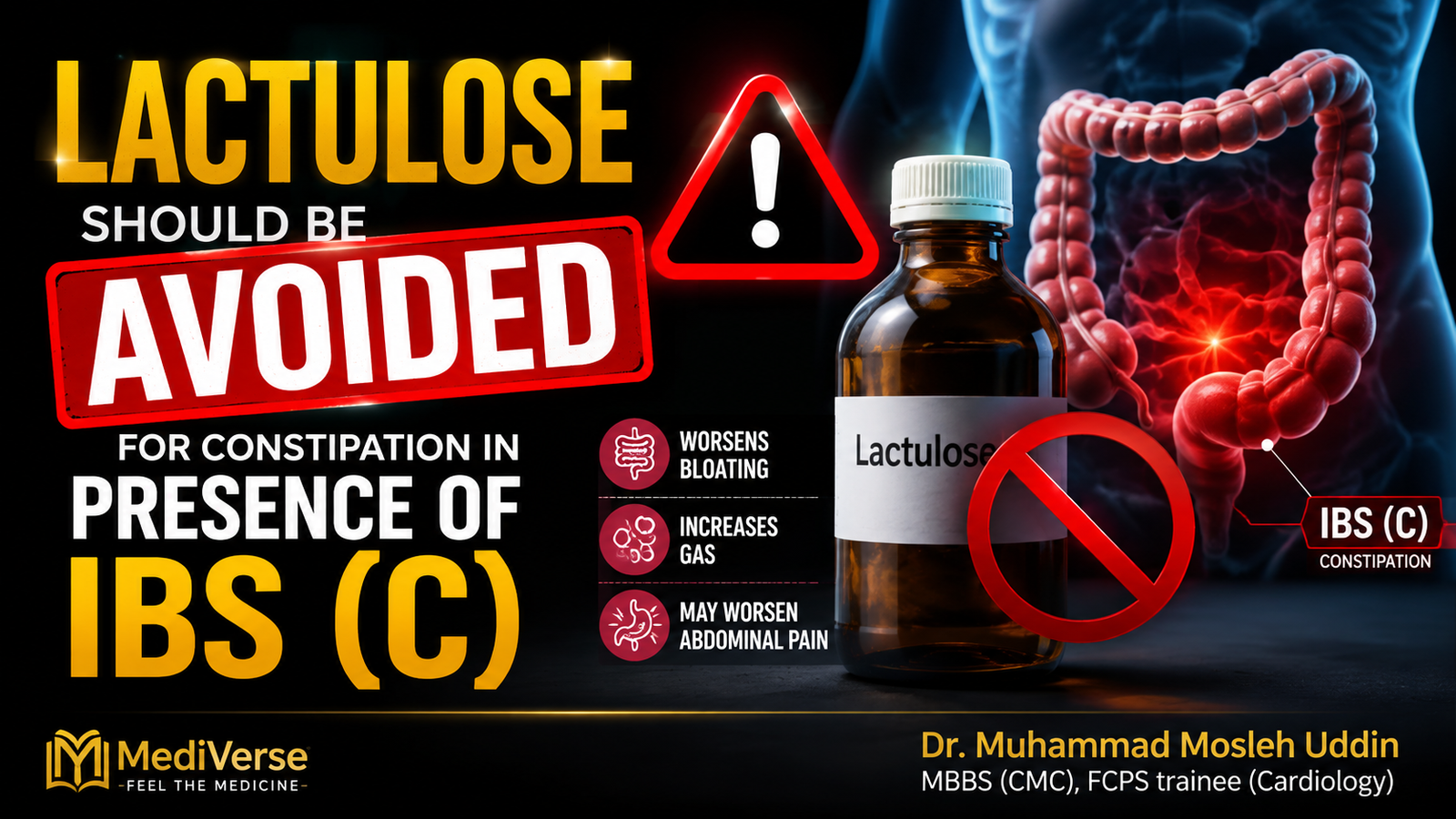
🎓Topic: Lactulose should be avoided for the treatment of constipation in presence of IBS (C)
🔷 IBS (C) means?
IBS (C) = Irritable bowel syndrome (Constipation predominant)
🔴 Why not?
Although lactulose is an osmotic laxative and can soften stools, in patients with IBS-C it often:
📌 Increases bloating
📌 Causes abdominal distension
📌 Produces more flatulence
📌 May worsen abdominal pain because bacterial fermentation of lactulose generates gas.
These are already prominent symptoms in IBS-C, so lactulose can make patients feel worse.
🔴 Preferred treatment of constipation in presence of IBS (C)
Current international guidelines (e.g., ACG, AGA, NICE) generally recommend:
🔷 First-line
📌 Lifestyle modification
📌 Adequate fluid intake
📌 Soluble fiber (especially psyllium)
🔷 For persistent constipation
📌 Polyethylene glycol (PEG/macrogol): Preferred osmotic laxative because it is less fermentable and causes less gas than lactulose.
📌 If symptoms remain troublesome:
- Linaclotide
- Plecanatide
- Lubiprostone (approved in some regions)
🔴 Is lactulose ever used?
Yes, but only if:
📌 PEG is unavailable or not tolerated.
📌 The main problem is constipation rather than pain/bloating.
📌 The patient accepts the possibility of increased gas and bloating.
🔷 Note :
It is not contraindicated, but it is not the preferred osmotic laxative in IBS-C.
🔴 Clinical summary
For a patient with IBS-C, choose:
📌 Psyllium containing diet
📌 PEG (macrogol) if a laxative is needed
📌 IBS-C-specific agents if symptoms persist
📌 Avoid routine use of lactulose because it commonly aggravates bloating and abdominal discomfort.
🔴 Are milk and leafy vegetables contraindicated in IBS-C?
No. Neither milk nor leafy vegetables are universally contraindicated.
🔷 Milk
- Not contraindicated in all IBS-C patients.
- However, if the patient has lactose intolerance, milk can worsen:
- Bloating
- Abdominal pain
- Diarrhea or altered bowel symptoms
- In such cases, use lactose-free milk or avoid lactose-containing dairy.
🔷 Leafy vegetables
- Generally encouraged as part of a healthy diet.
- Some vegetables contain high FODMAP carbohydrates and may increase gas in sensitive patients.
- Others are low FODMAP and are usually well tolerated.
🔷 Examples
📌 Better tolerated: spinach, lettuce
📌 May worsen bloating in some patients: - cabbage
- cauliflower
- broccoli (especially in larger amounts)
🔴 Practical dietary advice for IBS (C)
📌 Psyllium (Isabgol) is the preferred fiber supplement.
📌 Drink adequate water (at least 1.5–2 L/day unless contraindicated).
📌 Increase fiber gradually to reduce bloating.
📌 Trial a low-FODMAP diet if symptoms persist despite initial measures.
📌 Avoid those foods only if they consistently trigger that individual patient's symptoms.
📌 There is no universal ban on milk or leafy vegetables.
🔴 Why does psyllium usually cause less bloating?
Psyllium is a soluble, viscous, gel-forming fiber that is only slowly fermented by colonic bacteria.
In contrast, many other fibers (e.g., wheat bran, inulin) and lactulose are rapidly fermented, producing large amounts of gas (hydrogen, methane, carbon dioxide).
🔴 How does psyllium work?
- Absorbs water in the intestine.
- Forms a soft gel.
- Increases stool bulk and water content.
- Stimulates normal colonic motility.
- Because fermentation is slow, less gas is produced, so bloating is usually less than with lactulose.
🔴 But can psyllium still cause bloating?
Yes. It is not completely free from bloating.Patients may experience bloating if:
- They start with a high dose.
- They increase the dose too quickly.
- They do not drink enough water.
Therefore, guidelines recommend:
📌 Start with a low dose (e.g., 3–5 g/day).
📌 Increase gradually over 1–2 weeks.
📌 Take with 250–300 mL of water each dose.
🔴 Why are insoluble fibers often avoided?
Insoluble fibers (e.g., wheat bran) can:
- Increase abdominal pain
- Increase bloating
- Be less effective for IBS-C
Therefore, ACG, NICE, and British Society of Gastroenterology guidelines recommend soluble fiber (especially psyllium) rather than insoluble fiber for IBS-C.
🔴 SBA
A 30-year-old woman with IBS-C complains of constipation, bloating, and abdominal pain. Which osmotic laxative is preferred over lactulose?
A. Lactulose
B. Senna
C. Polyethylene glycol (PEG/macrogol)
D. Liquid paraffin
🔷 Answer: C. Polyethylene glycol (PEG/macrogol)
References
ACG Clinical Guideline: Management of Irritable Bowel Syndrome
AGA Clinical Practice Guideline for IBS-C
NICE Guideline: Irritable bowel syndrome in adults (CG61)
Davidson's Principles and Practice of Medicine (25th edition)
🎓Outdoor management series
Dr. Muhammad Mosleh Uddin
MBBS (CMC), FCPS trainee (Cardiology)