If BP is controlled with medication, is there any risk of CKD?
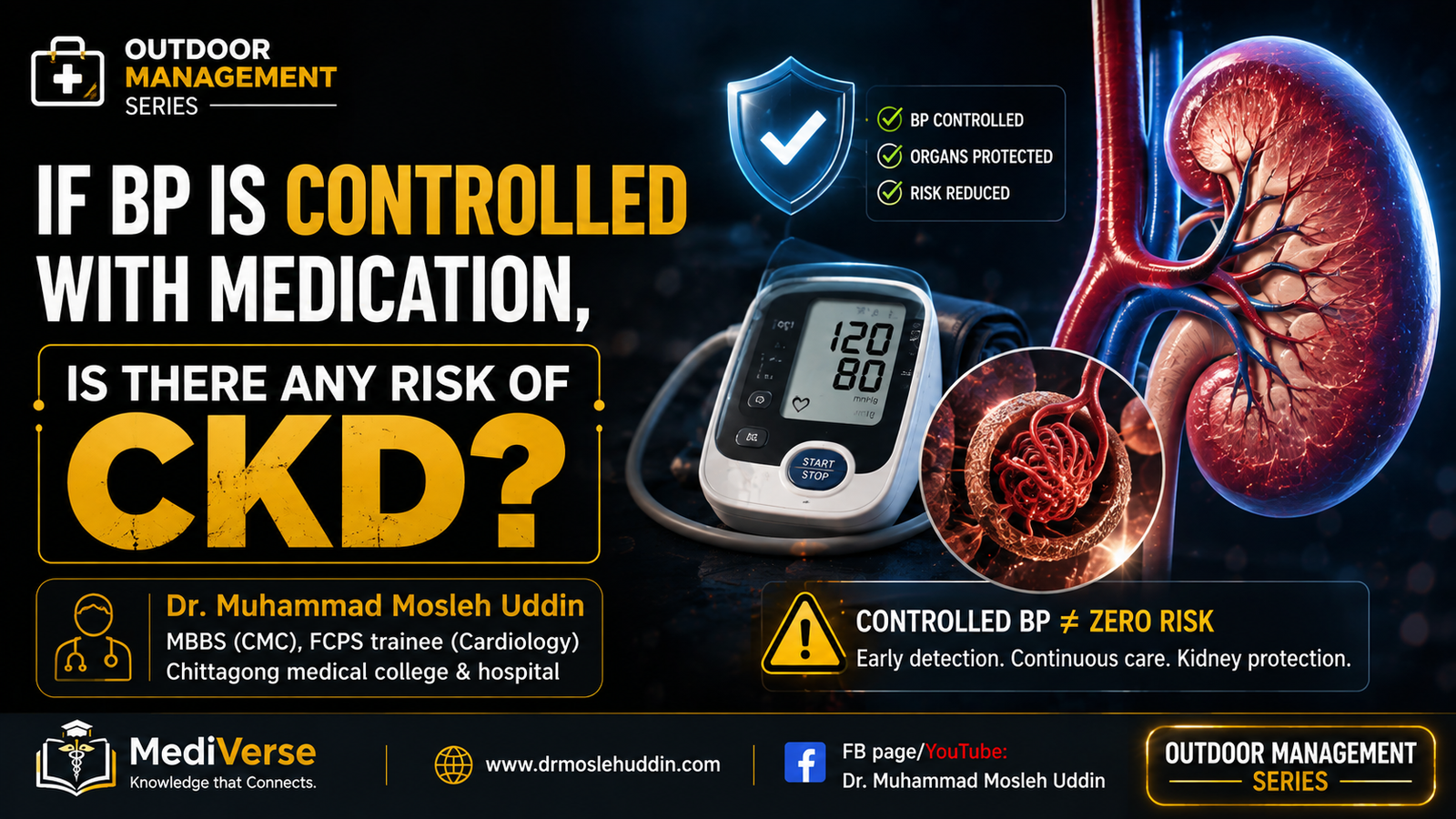
🔴 If BP is controlled with medication, is there any risk of CKD?
Yes, there can still be a risk of CKD even if hypertension is well controlled with medication, but the risk is substantially lower than with uncontrolled hypertension.
🔷 Pathophysiology of HTN induced CKD
Hypertension → Intraglomerular pressure ⬆️ → chronic vascular/glomerular injury → nephrosclerosis → ↓ nephron number → CKD
If antihypertensive treatment keeps BP controlled:
BP control → ↓ intraglomerular pressure + ↓ vascular/glomerular injury → slower renal damage → much lower CKD risk
🔷 WHO specifically recognizes uncontrolled hypertension as a major cause of chronic kidney disease and good BP control helps reduce the risk of developing CKD.
🔴 But why isn't the CKD risk zero?
Because hypertension may be only one of several risk factors:
🔷 Risk factors of CKD
📌 Diabetes mellitus
📌 Family history/genetic kidney disease
📌 Older age
📌 Obesity
📌 Previous AKI
📌 Proteinuria/albuminuria
📌 Smoking
📌 Recurrent nephrotoxic drug exposure
📌 Renal artery disease/vascular disease
📌 Previous glomerulonephritis
And importantly it may be that hypertension before diagnosis, may already have caused renal glomerular injury.
Controlling BP prevents further damage but doesn't necessarily reverse established nephron loss.
🔴 Clinically, what should you monitor?
For a patient with treated hypertension, don't rely on BP alone.
🔷 At least periodically check:
1. Serum creatinine → eGFR
2. Urine ACR → albuminuria
🔷 CKD can exist even when serum creatinine looks "normal", particularly when albuminuria is present. Persistent eGFR <60 mL/min/1.73 m² or persistent albuminuria can establish CKD depending on the clinical context.
So the conclusion is that,
🔷 Controlled BP ≠ no CKD risk.
Rather, BP control markedly reduces the risk of hypertensive kidney damage and slows CKD progression, but it does not eliminate CKD risk from hypertension.
If CKD/albuminuria is already present, ACE inhibitor or ARB therapy is particularly important in appropriate patients because of its antiproteinuric and renoprotective effects.
🔴 Thats why, guideline suggests ARB/ACEi as first line antihypertensive for HTN management in younger age (onset of HTN <55 Y of age)
🔷 KDIGO recommends RAS blockade for CKD with significant albuminuria, with monitoring of creatinine and potassium after initiation/dose escalation. As ACEi/ARB can cause Hyperkalemia or raised serum creatinine transiently.
🔴 SBA
A 52-year-old man has hypertension controlled at 125–130/75–80 mmHg on medication. His serum creatinine is 0.9 mg/dL. Which is the best test to screen for early hypertensive kidney involvement?
A. Serum urea
B. Serum uric acid
C. Urine albumin-to-creatinine ratio
D. Renal ultrasound
E. 24-hour urine volume
Answer: C. Urine albumin-to-creatinine ratio (ACR)
🔴 Why?
Albuminuria can detect renal damage before a significant fall in eGFR occurs.
References:
WHO Hypertension Guideline; WHO Kidney Disease guidance; KDIGO 2024 Clinical Practice Guideline for CKD; Davidson's Principles & Practice of Medicine; Harrison's Principles of Internal Medicine.
Dr. Muhammad Mosleh Uddin
MBBS (CMC), FCPS trainee (Cardiology)
Chittagong medical college & hospital