Management of Amlodipine induced Ankle edema
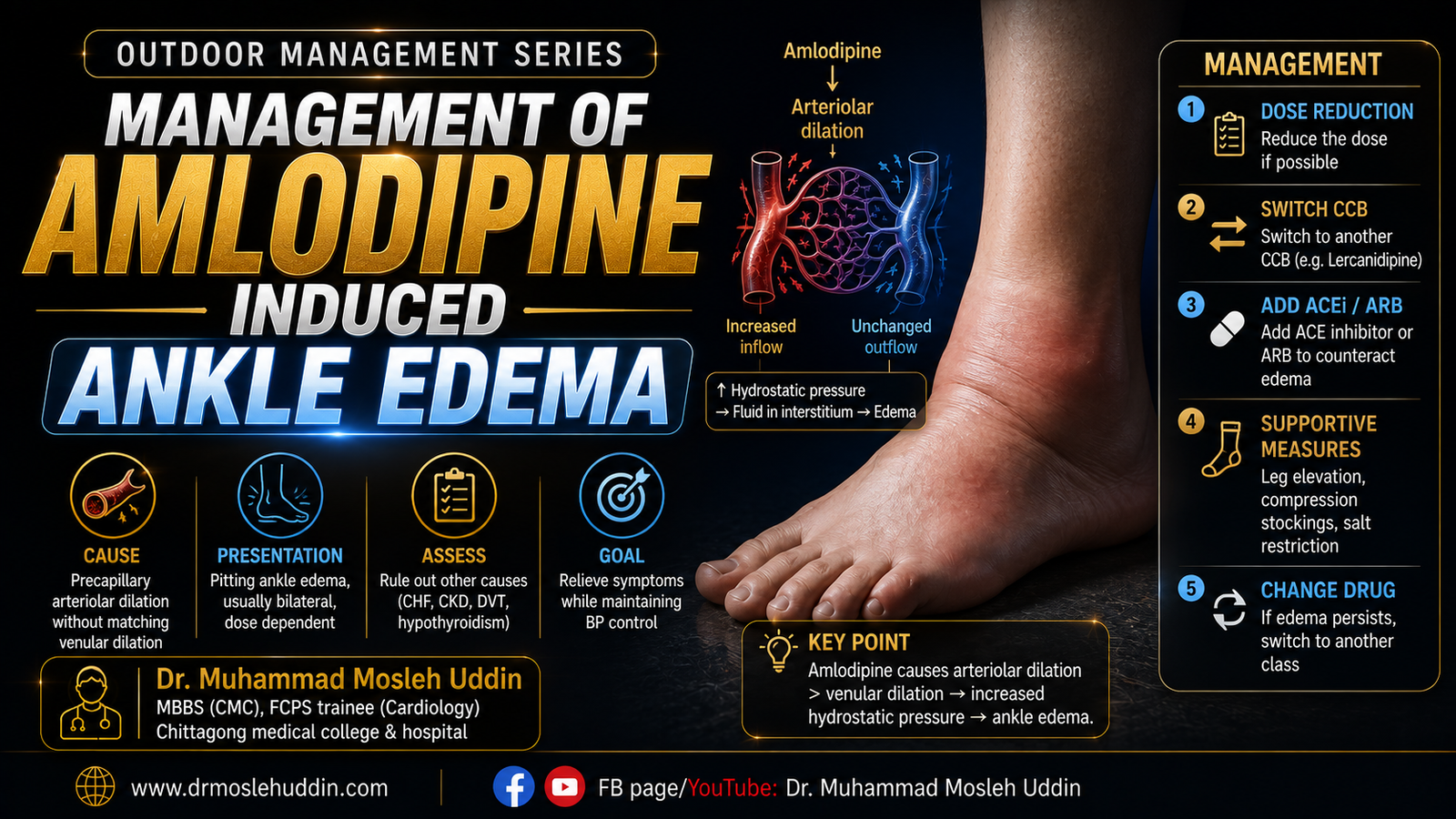
🔴 Management of Amlodipine induced ankle edema
কোন Hypertensive patient without history of CHF or IHD আপনার কাছে Bipedal pitting edema নিয়ে আসলে CHF and IHD এর other signs & symptoms আছে কিনা চেক করুন।
যেমন Exertional dyspnea, Exertional chest pain, PND, Raised JVP etc.
যদি এগুলো না থাকে তাহলে Extensive investigation এ যাওয়ার আগে Drugs history চেক করুন। দেখেন Amlodipine পাচ্ছে কিনা। যদি Amlodipine পেয়ে থাকে তাহলে বিসমিল্লাহ করে নিচের approach টা follow করতে পারেন ইনশা আল্লাহ।
🔴 Reduce the amlodipine dose
If the patient is taking:
Amlodipine 10 mg → reduce to 5 mg
Edema is dose-dependent, so this can substantially improve the problem.
If BP remains controlled at 5 mg, this is often the simplest solution.
🔴 Switch to equivalent dose of Cilnidipine
It causes less ankle edema
🔴 Add an ACE inhibitor or ARB
This is one of the most useful strategies when you want to retain amlodipine for BP control.
For example:
Amlodipine 10 mg → Amlodipine 5 mg + ARB
🔷 Note:
ACE inhibitors/ARBs reduce the precapillary and postcapillary pressure imbalance and can reduce CCB-associated edema. Evidence particularly supports ACE inhibitors for reducing CCB-related edema.
🔷 How does ACEI/ARB help here?
📌 Amlodipine
→ preferential arteriolar dilation
→ ↑ capillary hydrostatic pressure
→ edema
📌 ACEI/ARB
→ additional venous/postcapillary dilation
→ ↓ capillary hydrostatic pressure
→ ↓ fluid filtration and fluid reabsorption form interstitial space ⬆️
→ ankle edema ⬇️
So the combination is not simply "two antihypertensives"; there is a mechanistic correction of the edema.
🔴 If the patient has troublesome or persistent edema despite dose reduction of Amlodipine then stop the amlodipine and increase the dose of ARB/ACEi or choose another antihypertensive combination based on clinical context patients inshaaa ALLAH.
🔷 Alternatives include:
📌 ARB/ACE inhibitor
📌 Thiazide-like diuretic, e.g. indapamide/chlorthalidone
📌 Highly selective Beta-1 blocker
NICE's hypertension algorithm also supports combinations based around an ACEI/ARB, CCB and thiazide-like diuretic, with treatment individualized according to tolerance.
🚫 Don't routinely give furosemide to reduce amlodipine induced ankle edema.
The edema is primarily caused by increased capillary hydrostatic pressure, rather than generalized volume expansion.
That means,.Amlodipine edema ≠ fluid overload.
A diuretic may produce some symptomatic improvement in selected patients, but it does not correct the underlying mechanism and is generally not the preferred treatment for isolated CCB-induced edema.
If the patient actually has heart failure or another volume-overloaded state, that's different: then diuretic therapy may be indicated for the underlying disease.
🔴 Keep me in your prayer
🎓 Outdoor management series
Dr. Muhammad Mosleh Uddin
MBBS (CMC), FCPS trainee (Cardiology)